
Sitting in the Clark County Detention Center or waiting for your first court appearance on a drug charge can leave you wondering whether your future is ruined. That fear becomes even greater if the charging documents allege that you possessed drugs with the intent to sell them, because the potential penalties increase significantly compared to those for a possession for personal use conviction. You may also be confused about the charges you are facing if the police never caught you in the act of selling drugs. It is crucial to understand that an attempted or completed drug sale is not necessary to charge you with possession with intent to sell. It is equally important, however, to remember that an allegation is not a conviction. The prosecution must prove its case for you to be convicted of any drug charge. The best way to prevent that outcome is to consult with the experienced criminal defense lawyers at The Vegas Lawyers as soon as possible.
If you or a loved one were just arrested, take a breath. We are here to help. Contact us for a confidential case review.
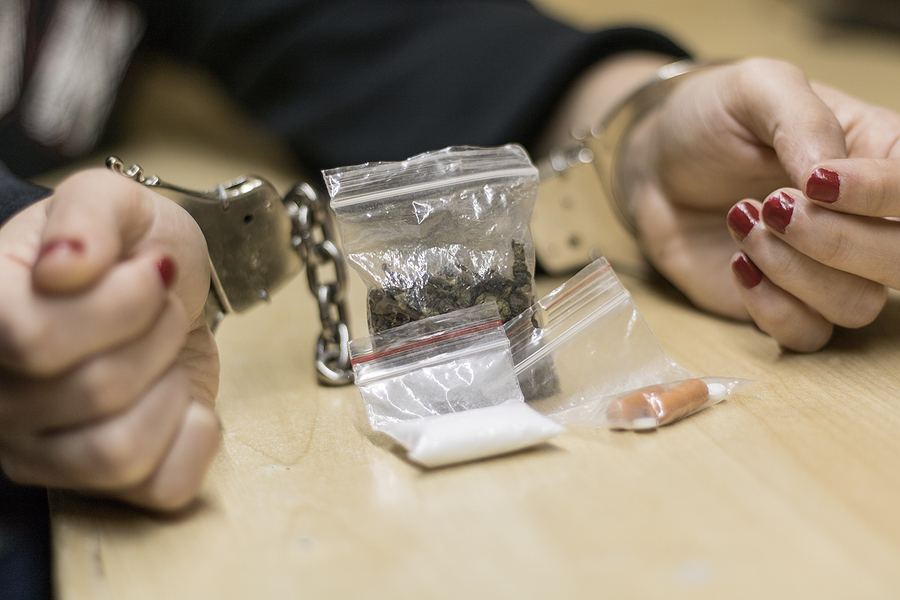
What Are You Actually Facing? Understanding Your Charges Under Nevada Law
Before you can focus on your defense, you need to have a clear understanding of the charges filed against you because possession for personal use and possession with intent to sell are different and distinct criminal charges under Nevada law.
Simple Drug Possession (NRS 453.336)
NRS 453.336 governs the knowing or intentional possession of a controlled substance without authorization when the drugs are not possessed for sale. In other words, drug possession for personal use. Typically, a first or second offense involving less than 14 grams of a Schedule I or II controlled substance, or less than 28 grams of a Schedule III, IV, or V substance is charged as a Category E felony. First offenders, however, may qualify for a diversion program that can reduce the charges or avoid a conviction altogether. Possession of an ounce or less of marijuana is charged as a misdemeanor.
Possession With Intent to Sell or Distribute (NRS 453.337 & 453.338)
Under NRS 453.337 & 453.338, it is unlawful to possess a controlled substance for the purpose of sale. The severity of the criminal charge and potential penalties are determined, in part, by the schedule of the controlled substance involved. NRS 453.337 generally covers Schedule I and II controlled substances, while NRS 453.338 applies to Schedule III, IV, and V substances.
A first offense under NRS 453.337 is generally a Category D felony, while a second offense is a Category C felony and a third or subsequent offense is a Category B felony. First and second offenses involving Schedule III, IV, or V substances under NRS 453.338 are usually Category D felonies.
The Fine Line: How Las Vegas Prosecutors Prove “Intent”
Contrary to what many people believe, you do not need to be caught handing drugs to another person in exchange for money to face a possession with intent to sell charge. Prosecutors can rely on circumstantial evidence to argue that you intended to sell the drugs.
Weight and Quantity
The most common type of circumstantial evidence used by prosecutors in a possession with intent to sell case is the weight and/or quantity of drugs involved. If the weight or quantity of drugs that you possessed is more than appears reasonable for personal consumption, the prosecutor can argue that you planned to sell the drugs despite any additional supporting evidence indicating sales.
Packaging, Scales, and Cash
During a search, police frequently look for items they associate with drug sales, including individually packaged drugs, digital scales, ledgers, and significant amounts of cash, particularly small-denomination bills. While these types of circumstantial evidence can be indicative of drug sales, they do not conclusively prove an intent to distribute drugs. Your defense attorney might point out that the drugs were purchased in individual bags from the dealer and the cash was lawfully earned in the form of tips at a job.
Cell Phone Evidence and Text Messages
Digital evidence, such as text messages, social media messages, and payment app records, can be powerful evidence in a possession-for-sale prosecution if that evidence provides a trail indicating the sale of drugs.
Potential Penalties: What’s on the Line in Nevada?
The potential penalties you face for a drug-related conviction can vary significantly depending on the schedule of the controlled substance, weight or quantity, and your criminal history (or lack thereof).
Penalties for Simple Possession (Category E Felony)
A charge for possession for personal use under NRS 453.336 is typically a Category E felony, carrying a possible term of imprisonment if convicted of one to four years. Qualifying first- or second-time offenders, however, will usually be eligible for drug court diversion or probation instead of having to spend time in prison.
Note that higher quantities or repeat offenses can move a possession case into Category D, C, or B felony territory, with significantly greater exposure.
Penalties for Possession with Intent to Distribute (Category D or C Felony)
For Schedule I or II substances governed by NRS 453.337, a first possession with intent to sell conviction is usually a Category D felony carrying one to four years in state prison and a fine of up to $5,000. A second offense is typically elevated to a Category C felony carrying one to five years and a fine of up to $10,000.
While your exact sentence may depend on various factors, such as the type and weight of drugs involved and any previous criminal convictions you have, the likelihood of receiving a probation-only sentence decreases significantly if you are convicted of possession with intent to sell. Moreover, the potential penalties increase in severity for subsequent convictions.
The Hidden Escalation: Drug Trafficking (NRS 453.3385)
Under NRS 453.3385, you can be charged with drug trafficking if the amount of drugs involved is high enough (for example, 100+ grams of a Schedule I substance such as cocaine or meth) even if there is zero evidence of an actual sale or the intent to sell. Trafficking is charged as a Category B or Category A felony, punishable by two to 20 years in prison or 25 years to life, respectively, if convicted.
The prosecutor is already building their case. Do not wait to secure your defense. Call The Vegas Lawyers today.
How The Vegas Lawyers Fight Drug Charges
It is imperative to keep in mind that being charged with a drug crime is not the same as being convicted of the crime and that defenses may be available to prevent a conviction. The defense strategy used in your case will depend on various factors, such as how the drugs were located, where they were located, and what direct and circumstantial evidence allegedly establishes possession or intent to sell.
Challenging Illegal Searches and Seizures
Because the Fourth Amendment protects you against unreasonable searches and seizures, your attorney may investigate and potentially challenge the search that resulted in locating the drugs. If the search was illegal, any evidence seized may be suppressed, meaning it cannot be used against you in court.
Disputing “Constructive Possession”
When drugs are not found directly in a defendant’s possession, the prosecution must rely on a “constructive possession” argument. To successfully argue constructive possession, the prosecution must prove that you had the intent and ability to control the drugs. Your attorney may attack this argument by showing that it was not your vehicle or home where the drugs were found or that someone else had more direct access to the drugs.
Negotiating “Intent” Down to “Simple Possession”
When prosecutors rely primarily on circumstantial evidence, the defense can attack the inference that the drugs were intended for sale. This often makes it easier for your attorney to negotiate a reduction in charges from possession with intent to sell to possession for personal use, opening the door to the possibility of diversion or probation instead of jail time.
What to Do Immediately After a Drug Arrest in Clark County
If you are arrested on drug charges in Clark County, taking the following three steps will protect you, your rights, and your future:
1. Do not try to talk your way out of a drug arrest. Statements intended to prove your innocence can provide investigators with information they did not previously possess and may ultimately be used against you.
2. Assert your right to remain silent and request an attorney. Never consent to the search of your home, vehicle, belongings, or phone. Making the police secure a warrant to search leaves avenues open for your attorney to challenge the search.
3. Contact The Vegas Lawyers as quickly as possible. Early representation allows your lawyer to preserve evidence, properly investigate the search, and potentially communicate with prosecutors before charging decisions have been made.
FAQ Section
Will I go to jail for a first-time drug possession charge in Nevada?
Not necessarily. First and second low-quantity possession offenses are generally Category E felonies that may qualify for diversion or probation in lieu of incarceration.
How do police prove I intended to sell drugs if they didn’t catch me selling?
Prosecutors may rely on circumstantial evidence, such as the quantity, packaging, scales, cash, communications, and payment records, to demonstrate an intent to sell.
Can a possession with intent to distribute charge be dropped to simple possession?
Potentially. A reduction is most likely when the prosecution cannot persuasively establish intent to sell or when other evidentiary or constitutional weaknesses affect the case.
What happens if the drugs belonged to my friend but were in my car?
The prosecution may attempt to establish constructive possession, making your knowledge of and control over the drugs important issues. Being near drugs, however, does not automatically prove possession.
Can police search my cell phone if I’m arrested for drugs in Las Vegas?
The police do not automatically have a right to search your phone, even if you are under arrest. Do not give them consent. Make them obtain a warrant.
Will a felony drug charge stay on my record forever in Nevada?
It will if you do nothing to remove it, but Nevada permits record sealing for many criminal cases after applicable requirements and waiting periods are satisfied.
Are the drug laws different on the Las Vegas Strip compared to the rest of Nevada?
The state and federal laws do not change on the Strip, but the way that law enforcement agencies and courts handle investigations and prosecutions can differ from one jurisdiction to another.
How much does a criminal defense lawyer cost in Las Vegas for a drug charge?
Fees vary based on the seriousness of the charge, complexity of the evidence, anticipated motions, and whether the case proceeds to trial. A consultation allows an attorney to evaluate the allegations before discussing the likely scope and cost of representation.