

Federal vs. State Charges in Nevada: What Cases Go to the U.S. Attorney’s Office?March 26, 2026

Getting arrested in Las Vegas is incredibly stressful. That stress multiplies when you discover your case is not heading to the local county courthouse but to federal court. Many people do not understand the difference until they are already caught in the system. As a defense team led by former Judge Tony Abbatangelo, we often see clients shocked by the sheer weight of a federal indictment.
The American justice system operates under two distinct levels of authority. State courts handle violations of local laws, while federal courts handle violations of the United States Code. Understanding which court system has jurisdiction over your case is the first step in building a strong, strategic defense.
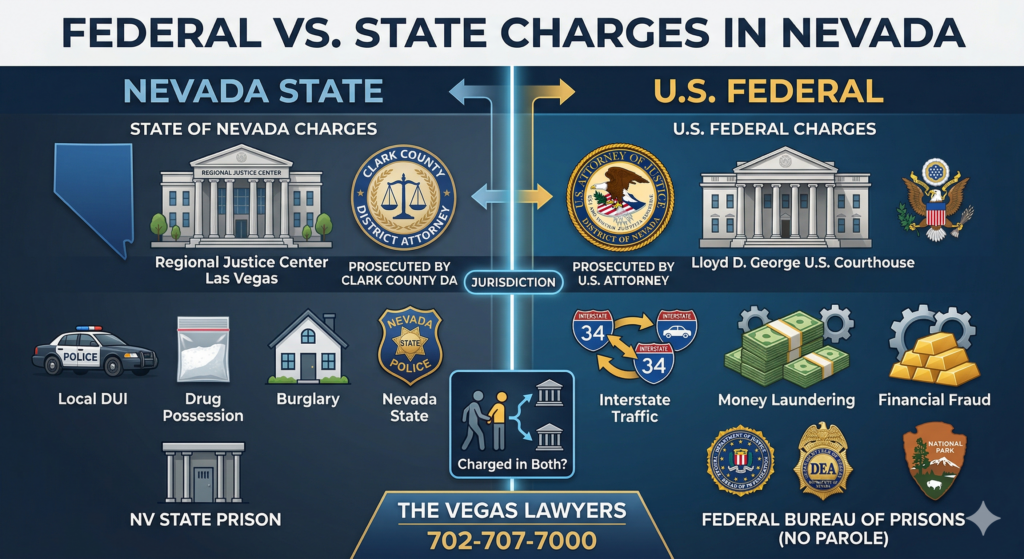
The Core Difference Between Federal and State Prosecution
The agency making the arrest and the jurisdiction of the crime dictate where your case ends up. The rules, procedures, and potential penalties differ drastically between the two systems.
Nevada State Court Jurisdiction
The vast majority of criminal cases in Las Vegas are state-level offenses. If you are arrested by the Las Vegas Metropolitan Police Department or the Nevada State Police, you will typically face prosecution by the Clark County District Attorney. These cases are heard at the Regional Justice Center.
State crimes include offenses such as standard DUI offenses, local drug possession, basic assault, domestic violence, and burglary. If convicted of a state crime, defendants serve their time in a county jail or a Nevada state prison facility.
Federal Court Jurisdiction
Federal cases are an entirely different challenge. They are investigated by large national agencies like the FBI, DEA, ATF, or IRS. Instead of a local district attorney, your opponent is the U.S. Attorney’s Office for the District of Nevada. These cases are prosecuted at the Lloyd D. George U.S. Courthouse in downtown Las Vegas. The federal government steps in when a crime violates federal statutes or involves national security and commerce interests.
Types of Crimes Handled by the U.S. Attorney’s Office
Federal prosecutors do not spend their time on low-level street crimes. They target complex, high-stakes offenses. A case typically lands on a federal prosecutor’s desk for a few specific reasons:
● The crime crosses state or international borders.
● The offense occurs on property owned by the federal government.
● The criminal activity involves federal agencies or federally insured institutions.
● The crime is part of a large, organized network, such as a major drug cartel.
● The conduct involves fraud, deception, or misrepresentation of or to the federal government.
● The crime involves an immigration or customs violation.
Crimes Crossing State Lines
The federal government regulates interstate commerce. If a crime crosses state borders, it automatically becomes a federal issue. In Las Vegas, this frequently involves drug trafficking rings moving narcotics from California into Nevada. It also includes wire fraud, mail fraud, and cybercrimes where the victims and perpetrators are located in different states. Human trafficking and child exploitation cases also typically fall under federal jurisdiction.
Crimes on Federal Property in Nevada
Jurisdiction is also geographic. Nevada has vast areas of land controlled by the federal government. If you commit a crime at Nellis Air Force Base, a federal courthouse, or a national park like Lake Mead, you are under federal jurisdiction. Even a simple DUI or drug possession charge at a federal recreation area bypasses state court and goes straight to the federal system.
Financial Crimes and Federal Agency Involvement
Las Vegas is a major financial hub, making it a target for complex white-collar crimes. Bank fraud, money laundering, counterfeiting, and tax evasion are prime targets for federal investigators. Because these crimes impact federal institutions like national banks or the Internal Revenue Service, the U.S. Attorney’s Office aggressively pursues them.
Can You Be Charged in Both State and Federal Court?
A common misconception is that charging someone in both state and federal court violates the protection against double jeopardy. The United States Constitution prevents you from being tried twice for the same crime by the same sovereign. However, the state of Nevada and the federal government are considered two completely separate sovereign entities.
This means you can face state and federal charges for the same incident. For example, robbing a bank violates Nevada state law against robbery and federal laws protecting federally insured banks. While it is rare for both entities to pursue a trial simultaneously, they have the legal right to do so. Often, local prosecutors will defer to the federal government if the U.S. Attorney decides to pick up the case.
How Federal Criminal Defense Differs from State Defense
Defending a federal case requires a completely different legal strategy than a state case. An attorney who excels in state court may be completely out of their depth in the federal system.
The Power of Federal Resources
When the U.S. Attorney’s Office brings an indictment, they have usually been building their case for months or even years. Federal investigators have virtually unlimited resources, access to extensive wiretaps, financial subpoenas, and cooperating witnesses. By the time an arrest is made, the federal prosecutor believes they have an airtight case. From a judicial perspective, we know that breaking down a federal case requires meticulous attention to detail and a deep understanding of federal constitutional law.
Federal Sentencing Guidelines
The penalties in federal court are notoriously severe. State judges often have significant discretion when sentencing, allowing for probation or reduced terms in many non-violent cases. Federal judges, however, are guided by the United States Federal Sentencing Guidelines. These are strict mathematical formulas based on the severity of the offense and the defendant’s criminal history. Furthermore, there is no parole in the federal prison system. If convicted, defendants serve nearly their entire sentence.
Frequently Asked Questions (FAQ)
Yes. Federal drug charges almost always involve trafficking, manufacturing, or distribution rather than simple possession. They frequently carry mandatory minimum prison sentences, meaning the judge has no choice but to impose a specific number of years in federal prison if you are convicted.
Yes. If local police uncover a crime that violates federal law, they can hand the investigation over to federal agencies. This frequently happens in Las Vegas with large-scale drug busts or cases involving illegal firearms. The state will typically drop its local charges once the federal indictment is formally secured.
Federal investigations are slow and highly secretive. You might receive a target letter from the U.S. Attorney’s Office, or agents might show up at your home or workplace for a casual interview. Never speak to federal agents without an attorney present, and do not respond to a target letter without first consulting with an attorney. Early intervention by a lawyer can sometimes prevent an investigation from turning into a formal indictment.
What to Do Next
Finding out you or a loved one is facing federal prosecution can feel overwhelming. The rules are stricter, the penalties are harsher, and the opposition has immense resources at its disposal. However, no case is unbeatable when you have the right legal strategy in place from the very beginning.
If you suspect you are under federal investigation or have already been charged by the U.S. Attorney’s Office, reaching out for knowledgeable counsel is your best defense. The team at The Vegas Lawyers is here to review the facts, protect your rights, and provide clear guidance through this complex process. Give us a call at 702-707-7000 to discuss your situation.